
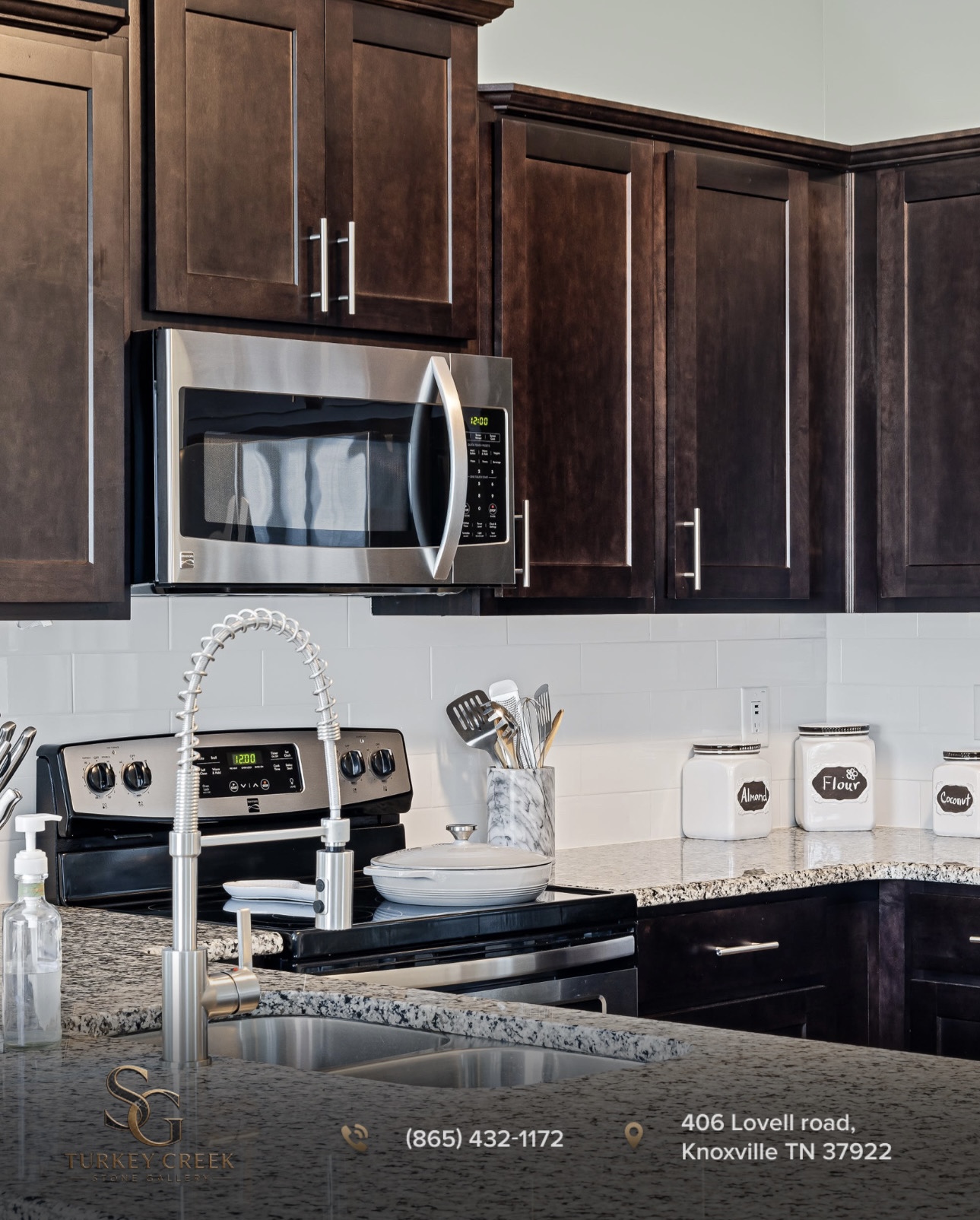
A kitchen sink should ideally have at least 24 inches of clear countertop space on one side and 18 inches on the other. These dimensions are commonly recommended by the National Kitchen & Bath Association (NKBA) because they provide practical landing areas for washing dishes, preparing food, and handling groceries.
At Turkey Creek Stone Gallery, we help homeowners plan sink placement before countertop fabrication begins. When selecting kitchen countertops in Knoxville, TN, we consider sink dimensions, cabinet placement, available workspace, and how the kitchen is used every day.
The goal is not simply to fit a sink into the countertop. It is to create enough usable space around it for comfortable kitchen routines.
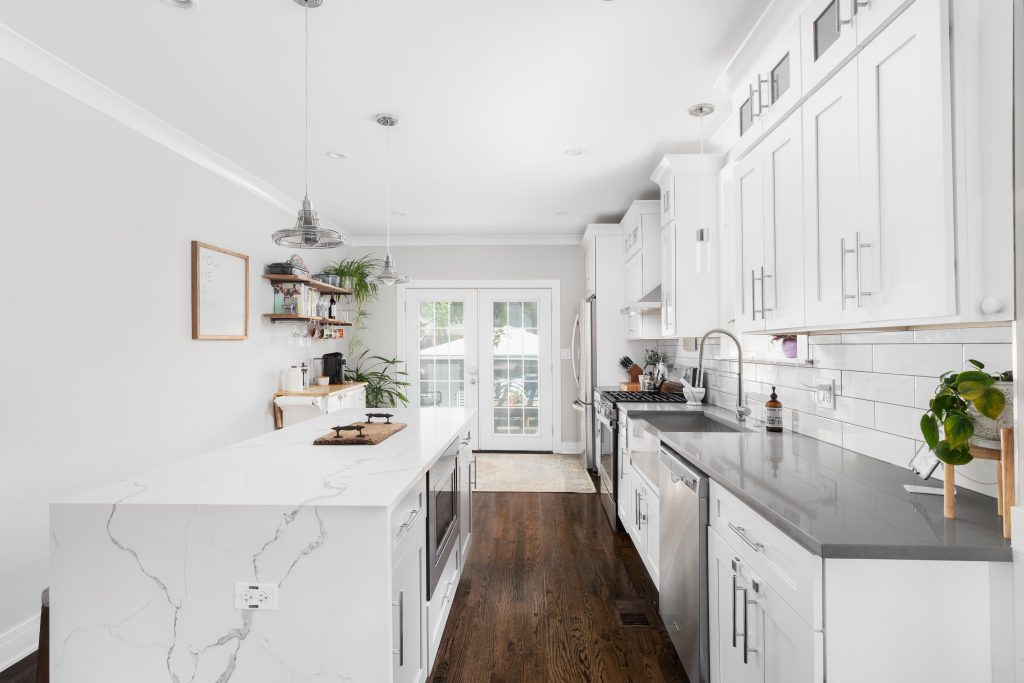
How Much Countertop Space Is Recommended on Each Side of a Sink?
The NKBA recommends a minimum of 24 inches of landing space on one side of the sink and 18 inches on the other, measured from the sink edge.
These are kitchen planning recommendations rather than universal building-code requirements.
| Sink configuration | Recommended countertop space | Purpose |
|---|---|---|
| One side of the sink | 24 inches | Main preparation and dish-handling area |
| Opposite side | 18 inches | Secondary landing and drying space |
| Small kitchen | Maximize available clear space | Maintain functional access |
| Sink near a corner | Account for corner clearance | Prevent restricted movement |
| Island sink | Preserve preparation space | Support cooking and cleanup |
We generally recommend placing the larger landing area on the side used most frequently for food preparation.
For example, if the dishwasher is positioned to the right of the sink, the left side may be more convenient for cutting vegetables and preparing meals.
Why Does Countertop Space Around the Sink Matter?
Countertop space around the sink matters because it supports several kitchen activities that often happen simultaneously.
Homeowners use this area to rinse produce, prepare ingredients, wash cookware, and organize dishes.
Without enough space, these activities can interfere with one another.
A sink positioned too close to a refrigerator, tall cabinet, or corner may also limit movement.
When planning kitchen countertops in Knoxville, TN, we recommend evaluating how the sink relates to surrounding appliances and cabinets.
A few additional inches of usable workspace can make a noticeable difference in daily convenience.
Is 18 Inches Enough Countertop Space Beside a Sink?
Eighteen inches can provide a functional secondary landing area, but it may feel limited when used as the main food preparation space.
This amount of countertop can accommodate a small dish rack, a few dishes, or basic kitchen tools.
However, larger cutting boards and multiple food containers require more room.
We recommend reserving the wider side of the sink for tasks that involve chopping, mixing, and organizing ingredients.
For homeowners with limited kitchen space, a sink cover or fitted cutting board may provide additional temporary workspace.
These accessories should be compatible with the sink manufacturer’s specifications.
Should the Sink Be Centered in the Countertop?
Not necessarily. A sink does not need to be centered if an offset position creates a more functional kitchen layout.
Centered sinks can look balanced, especially beneath windows.
However, visual symmetry should not take priority over practical countertop space.
For example, positioning a sink slightly toward one side may create a longer uninterrupted preparation area.
At Turkey Creek Stone Gallery, we recommend reviewing sink placement alongside cabinet dimensions and appliance locations before final measurements.
This helps avoid unnecessary countertop seams and awkwardly positioned cutouts.
How Much Space Should Be Between a Sink and a Stove?
The ideal distance between a sink and stove depends on the kitchen layout, but providing approximately 36 inches of uninterrupted preparation space between them is a useful planning target.
This creates room for washing ingredients, cutting vegetables, and transferring food to cookware.
Smaller kitchens may not accommodate that distance.
In those cases, we recommend prioritizing safe landing areas around the cooking surface and maintaining a practical preparation zone.
| Distance between sink and stove | Practical consideration |
|---|---|
| Less than 18 inches | Limited preparation space |
| 18-24 inches | Can support basic food preparation |
| 24-36 inches | More comfortable for everyday cooking |
| 36 inches or more | Provides additional room for multiple tasks |
These ranges are general planning guidance, not mandatory construction standards.
We also consider the location of electrical outlets, backsplash materials, and appliance clearances.

How Does Sink Size Affect Available Countertop Space?
Larger sinks reduce the amount of uninterrupted countertop available within a fixed cabinet run.
A 33-inch sink, for example, occupies more horizontal space than a 25-inch sink.
The actual countertop opening depends on the sink model and installation method.
When choosing kitchen countertops in Knoxville, TN, we recommend selecting the sink before fabrication.
This allows us to plan the cutout accurately and confirm that sufficient stone remains around the opening.
Is a Single-Bowl Sink Better for Small Kitchens?
A single-bowl sink can be practical in smaller kitchens because it provides a large washing area without requiring separate compartments.
However, its overall dimensions still determine how much countertop space remains.
We recommend comparing sink widths rather than assuming every single-bowl model saves space.
Are Undermount Sinks Better for Countertop Space?
Undermount sinks can create a clean transition between the countertop and sink opening, making it easier to wipe crumbs and water directly into the basin.
However, they do not automatically increase the usable countertop area.
The sink’s dimensions and required cutout determine how much stone remains.
Which Countertop Materials Work Best Around a Kitchen Sink?
Granite, quartz, and marble can all be used around kitchen sinks, but their moisture resistance and maintenance requirements differ.
Quartz is generally nonporous, while granite and marble may require sealing depending on the stone.
At Turkey Creek Stone Gallery, we help homeowners compare materials based on durability, appearance, and daily cleaning requirements.
| Material | Water and stain resistance | Heat resistance | Maintenance |
|---|---|---|---|
| Granite | Varies by stone and sealing | Generally good | Some varieties require sealing |
| Quartz | Generally high | Excessive heat can damage resin | No sealing required |
| Marble | More susceptible to staining and etching | Naturally heat-resistant | Careful cleaning and appropriate sealing |
For busy kitchens, quartz and granite are often practical choices.
Marble can also be used successfully, but homeowners should understand its sensitivity to acidic substances and certain cleaning products.
We recommend wiping standing water from the sink area and maintaining the seal between the countertop and sink.
Does Sink Placement Affect Countertop Durability?
Yes. Sink placement affects the amount of stone surrounding the cutout and the support required during installation.
A large sink opening creates narrow sections of countertop at the front and back of the basin.
These areas must be fabricated and supported appropriately.
We recommend following the stone fabricator’s requirements for minimum clearances, reinforcement, and cabinet support.
Sink cutouts positioned too close to seams or unsupported edges may require adjustments to the layout.
When working with kitchen countertops in Knoxville, TN, we review these details before fabrication begins.
How Much Do Granite, Quartz, and Marble Countertops Cost?
Our starting material prices are $45 per square foot for granite, $60 for quartz, and $65 for marble.
These are starting material prices rather than complete installed project costs.
The final quote depends on the selected slab, countertop dimensions, edge profiles, sink cutouts, fabrication requirements, and installation conditions.
| Material | Starting material price | Example for 40 sq ft |
|---|---|---|
| Granite | $45/sq ft | $1,800 |
| Quartz | $60/sq ft | $2,400 |
| Marble | $65/sq ft | $2,600 |
These examples illustrate the basic material cost for a 40-square-foot countertop project.
Additional expenses may include sink cutouts, edge finishing, installation labor, and plumbing coordination.
A larger sink does not necessarily increase the amount of stone purchased, but specialized cutouts and installation requirements can affect fabrication costs.
We recommend finalizing the sink model before requesting a detailed estimate.
How Long Does Countertop Fabrication and Installation Take?
A countertop project generally takes approximately 7-10 days, depending on finalized measurements, material availability, fabrication complexity, and installation scheduling.
The sink model and installation method should be confirmed before fabrication.
At Turkey Creek Stone Gallery, our typical process includes:
- Review the kitchen layout: Confirm cabinet dimensions and sink placement.
- Select the material: Compare granite, quartz, marble, and available finishes.
- Complete measurements: Record countertop dimensions and appliance openings.
- Fabricate the countertop: Cut the stone, prepare sink openings, and finish edges.
- Complete installation: Position, level, secure, and finish countertop sections.
- Coordinate sink installation: Confirm support, sealing, and plumbing requirements.
We recommend avoiding changes to the sink model after fabrication begins.
Even small differences in sink dimensions can affect the countertop opening.
What Mistakes Should You Avoid When Planning Sink Countertop Space?
The most common mistake is choosing a sink based only on appearance without measuring the remaining workspace.
Another issue is positioning the sink too close to a corner or tall cabinet.
We also recommend avoiding sink cutouts that leave insufficient stone support around the opening.
For homeowners planning kitchen countertops in Knoxville, TN, we suggest reviewing the following before fabrication:
- Clear countertop space on both sides of the sink
- Distance between the sink and cooking surface
- Dishwasher placement and door clearance
- Sink dimensions and installation requirements
- Countertop seams and structural support
- Available space for dish drying and food preparation
A well-planned sink area should support everyday activities without creating unnecessary movement or clutter.

Frequently Asked Questions About Countertop Space Around a Kitchen Sink
1. What Is the Minimum Recommended Countertop Space Beside a Sink?
The NKBA recommends 24 inches on one side and 18 inches on the other as practical kitchen planning guidelines.
2. Can a Sink Be Installed Close to a Wall?
Yes, but sufficient clearance should remain for comfortable use, faucet operation, and proper countertop support.
3. Is a 30-Inch Sink Too Large for a Small Kitchen?
Not necessarily. The answer depends on cabinet dimensions and the remaining preparation space.
4. Should the Dishwasher Be Next to the Sink?
Yes, placing the dishwasher near the sink generally simplifies loading and cleanup.
5. Does an Undermount Sink Require Special Countertop Support?
Yes. Undermount sinks require an appropriate mounting and support system compatible with the sink and countertop materials.
6. Can You Change Sink Placement During a Countertop Remodel?
Yes, but relocating the sink may require cabinet modifications and plumbing work.
7. Which Countertop Material Is Best Around Water?
Quartz is generally low-maintenance because it is nonporous, while properly maintained granite and marble can also perform well around sinks.
Where Can You Find Kitchen Countertop Installation Services in Knoxville, TN?
Turkey Creek Stone Gallery is based in Knoxville, TN, and serves homeowners in Knoxville, Dayton, Newport, and surrounding Tennessee communities.
We help customers select granite, quartz, marble, and other stone materials while coordinating countertop measurements, sink cutouts, fabrication, edge finishing, and installation.
If you are planning kitchen countertops in Knoxville, TN, we can help you evaluate sink placement, available preparation space, and material options before fabrication begins.
Our goal is to create countertops that fit your kitchen layout and support comfortable everyday use.