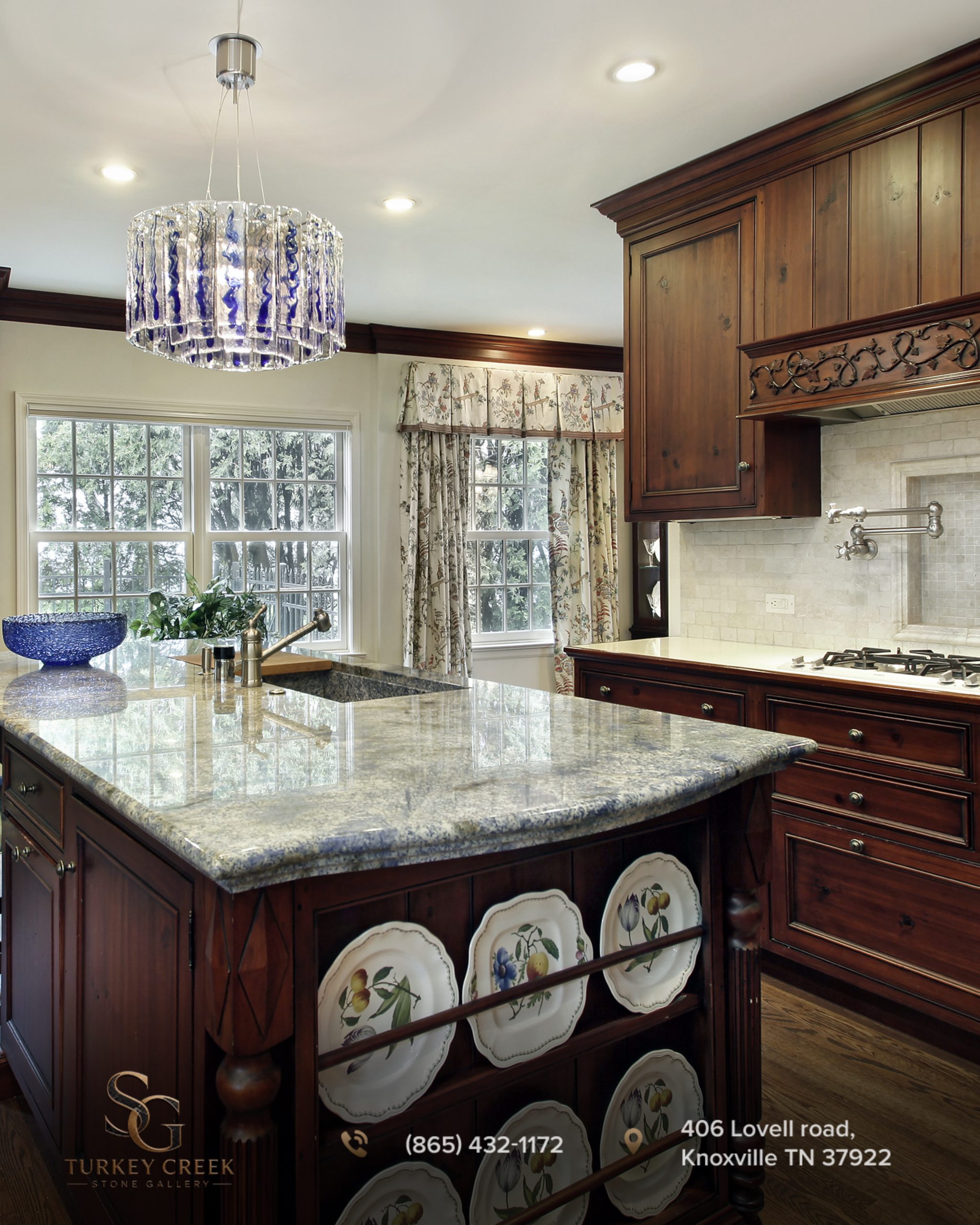
Countertop veins should run in a direction that complements the kitchen layout, creates visual continuity, and minimizes awkward pattern breaks. The best orientation depends on the slab’s natural movement, countertop dimensions, island placement, and seam locations.
At Turkey Creek Stone Gallery, we help homeowners understand how vein direction affects the finished appearance before fabrication begins. When comparing granite companies in Knoxville, TN, it is important to choose a fabricator who considers the actual slab pattern rather than simply cutting pieces to fit the cabinets.
A well-planned layout can make a countertop look more cohesive without changing the material itself.

Why Does Vein Direction Matter in Stone Countertops?
Vein direction matters because it influences how the eye moves across the countertop and how different sections of stone connect visually.
Natural stone patterns are rarely uniform. Some slabs have long diagonal veins, others feature horizontal movement, and certain varieties contain irregular mineral formations.
For example, marble with long gray veins can create a continuous visual line across a kitchen island. Rotating that slab may produce a completely different appearance, even though the material is identical.
We evaluate the direction of the strongest patterns before creating the cutting layout.
Vein orientation also affects where seams should be positioned. When veins continue naturally between adjoining sections, the joint may become less noticeable.
Should Countertop Veins Run Lengthwise or Across the Countertop?
For long kitchen islands and straight countertop runs, lengthwise veins often create the most natural visual flow. However, crosswise or diagonal patterns can work equally well when they complement the layout.
The right direction depends on the stone’s appearance and the surrounding kitchen design.
| Vein direction | Visual effect | Best application |
|---|---|---|
| Lengthwise | Makes the surface appear longer and more continuous | Kitchen islands and long countertops |
| Crosswise | Emphasizes countertop depth and width | Wide islands and selected feature surfaces |
| Diagonal | Introduces movement across the surface | Large islands and statement countertops |
| Irregular | Highlights natural mineral variation | Granite and other heavily patterned stones |
| Bookmatched | Creates mirrored patterns across adjoining pieces | Feature walls and large stone installations |
We generally recommend evaluating several orientations using the actual slab.
A dramatic diagonal vein may look attractive in isolation but become distracting if it ends abruptly at a sink or countertop seam.
How Do You Choose Vein Direction for a Kitchen Island?
The best vein direction for a kitchen island depends on its shape, viewing angles, and the natural movement within the selected slab.
For rectangular islands, running prominent veins along the longer dimension often creates a more continuous appearance.
However, the location of the sink, cooktop, and seating area can influence the decision.
At Turkey Creek Stone Gallery, we encourage homeowners to consider where they will see the island most frequently.
For example, an island viewed primarily from the living room may benefit from a pattern that leads the eye toward the kitchen.
Does Vein Direction Make a Kitchen Island Look Bigger?
Yes, vein direction can influence the perceived proportions of a kitchen island, although it does not change its actual size.
Long, continuous veins may visually emphasize length, while crosswise patterns can draw attention to the island’s width.
We often recommend simpler pattern placement when cabinetry, lighting, and surrounding finishes already contain strong visual details.
For homeowners researching granite companies in Knoxville, TN, comparing full slabs is particularly useful because small samples rarely show the complete pattern movement.
How Should Veins Run on Waterfall Countertops?
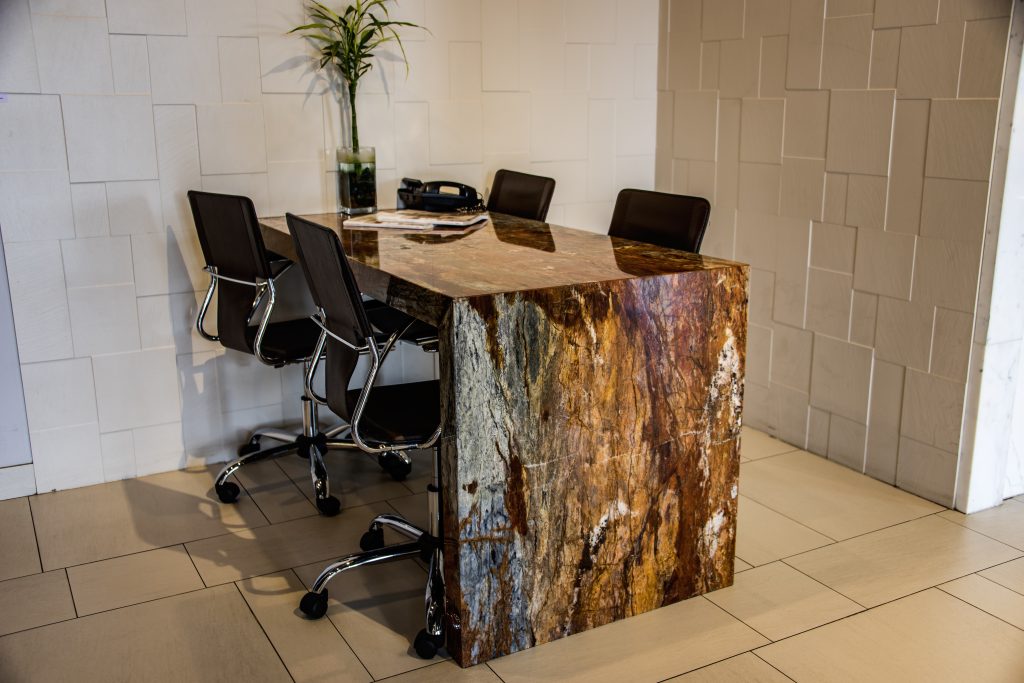
Waterfall countertop veins should ideally continue from the horizontal surface down the vertical side panel when the selected stone and fabrication layout permit it.
This creates the appearance of a continuous stone surface.
The most important consideration is how the pattern transitions over the edge.
A waterfall countertop with disconnected veins may still look attractive, but a well-matched transition creates a more intentional design.
Can You Match Veins Across a Waterfall Edge?
Yes. Fabricators can sometimes align patterns across waterfall edges through careful slab layout and mitered fabrication.
However, a perfect continuation is not possible with every slab or design.
We evaluate the stone’s pattern, available dimensions, cutting allowances, and material requirements before confirming the layout.
Strongly directional marble or quartz patterns may require additional material to achieve the desired effect.

Does Vein Direction Affect Countertop Seams?
Yes. Vein direction can make countertop seams more or less noticeable depending on how the patterns align between adjoining pieces.
A seam that interrupts a prominent vein may attract attention even when the joint is narrow and properly finished.
We consider seam placement during slab layout instead of making that decision only during installation.
When customers compare granite companies in Knoxville, TN, we recommend asking how the fabricator plans to coordinate pattern movement across multiple countertop sections.
Can Veins Be Matched Across Two Slabs?
Yes, vein matching is sometimes possible, particularly when slabs come from consecutive cuts of the same stone block.
However, natural slabs are not identical, and exact continuity cannot always be achieved.
We also distinguish between vein matching and bookmatching.
Vein matching attempts to create a continuous pattern, while bookmatching places adjoining slab faces in a mirrored arrangement.
Both methods require careful planning before fabrication.
Is Vein Direction Different for Granite, Quartz, and Marble?
Yes. Granite, quartz, and marble have different pattern characteristics, which influence how their visual movement should be positioned.
Granite often contains irregular mineral formations, marble frequently features pronounced natural veins, and engineered quartz can offer more consistent patterns.
| Material | Typical pattern characteristics | Vein direction considerations |
|---|---|---|
| Granite | Mineral movement, speckles, bands, or flowing patterns | Orientation depends on the individual slab |
| Quartz | Consistent manufactured patterns or marble-inspired veining | Repeating designs may require careful alignment |
| Marble | Natural veins that vary in direction and intensity | Strong veins benefit from detailed layout planning |
| Quartzite | Natural flowing patterns and distinct mineral formations | Slab orientation can strongly affect appearance |
At Turkey Creek Stone Gallery, we recommend reviewing the actual material rather than relying exclusively on catalog images.
For example, Fantasy Brown, a natural stone often marketed as granite or marble depending on the supplier, can display strong flowing patterns. Its classification should be confirmed for the particular slab.
Calacatta-style quartz, meanwhile, may feature large manufactured veins that require careful positioning around seams.
Does Vein Direction Affect Stone Durability?
Vein direction does not automatically determine countertop durability, but natural fissures, material structure, cutouts, and support conditions can influence fabrication decisions.
A visible vein is not necessarily a structural weakness.
Some natural stones contain mineral boundaries or fissures that require evaluation before cutting.
We pay particular attention to narrow sections around sinks and cooktops, where stone pieces may be more vulnerable during handling.
The selected material also determines everyday maintenance requirements.
| Feature | Granite | Quartz | Marble |
|---|---|---|---|
| Scratch resistance | Generally good | Generally good | More susceptible to scratches |
| Heat resistance | Good, but thermal shock is possible | Excessive heat can damage resin | Naturally heat-resistant but vulnerable to thermal shock |
| Stain resistance | Varies by stone and sealing | Generally strong | More susceptible to staining |
| Acid resistance | Depends on mineral composition | Generally good against common household acids | Vulnerable to etching |
| Maintenance | Some varieties need sealing | No sealing required | Careful cleaning and appropriate sealing |
We explain these differences because appearance should not be the only factor when selecting a countertop.
Can Vein Direction Increase Countertop Fabrication Costs?
Yes. Special vein matching, diagonal layouts, and waterfall designs can increase fabrication costs when they require additional material or more complicated cutting.
The amount of usable stone remaining after fabrication is an important consideration.
For example, rotating a countertop template to follow a particular vein may reduce the number of pieces that fit within one slab.
That can create additional material requirements.
For homeowners comparing granite companies in Knoxville, TN, we recommend discussing both appearance and material efficiency before approving a cutting layout.
How Much Do Granite, Quartz, and Marble Countertops Cost?
Our listed starting material prices are $45 per square foot for granite, $60 for quartz, and $65 for marble. Final pricing depends on material selection, slab dimensions, fabrication complexity, and installation requirements.
The following examples illustrate starting material costs for a 40-square-foot countertop project.
| Material | Starting price per sq. ft. | Material cost for 40 sq. ft. |
|---|---|---|
| Granite | $45 | $1,800 |
| Quartz | $60 | $2,400 |
| Marble | $65 | $2,600 |
These figures are not guaranteed installed totals.
Special pattern matching, additional slabs, decorative edges, sink cutouts, and complex installation conditions may affect the final estimate.
We recommend reviewing the slab layout and the complete project quote before fabrication begins.
How Is Vein Direction Planned During Fabrication?
Vein direction is planned by comparing the approved countertop measurements with the actual slab pattern before cutting.
We consider both the appearance of the stone and the practical requirements of fabrication.
Our typical planning process includes:
- Review the kitchen layout: Identify islands, countertop runs, sinks, and appliances.
- Inspect the slab: Evaluate prominent veins, mineral patterns, and natural variations.
- Determine orientation: Choose the direction that works with the countertop design.
- Plan seams: Coordinate adjoining sections where matching is feasible.
- Approve the cutting layout: Confirm appearance and material requirements.
- Fabricate and install: Cut, finish, and position the stone according to the approved plan.
At Turkey Creek Stone Gallery, we encourage customers to communicate their pattern preferences before cutting begins.
Changes after fabrication may require additional material or replacement sections.
How Long Does Countertop Fabrication and Installation Take?
Countertop fabrication and installation can typically take approximately 7-10 days after final measurements and project details are confirmed, depending on material availability and scheduling.
More complicated vein-matching requirements may require additional preparation.
When planning projects with granite companies in Knoxville, TN, homeowners should finalize their slab selection, cabinet layout, and sink specifications before templating.
We also recommend confirming waterfall edges and special seam arrangements early.
These decisions help avoid unexpected changes during production.
Frequently Asked Questions About Countertop Vein Direction
1. Should Veins Run Horizontally or Vertically?
Either direction can work. We recommend choosing the orientation that complements the countertop shape and creates the most natural pattern flow.
2. Can You Change Vein Direction During Installation?
Generally, no. Vein direction is established during cutting, so significant changes usually require refabrication.
3. Should Kitchen Island Veins Match Perimeter Countertops?
Not necessarily. Matching patterns can create continuity, but contrasting orientations may also work when intentionally planned.
4. Can Quartz Countertop Veins Be Matched?
Yes, some quartz patterns can be aligned across adjoining pieces, although exact results depend on the manufacturer’s design and slab layout.
5. Do All Granite Slabs Have Directional Veins?
No. Some granite varieties have relatively uniform speckled patterns, while others feature strong directional mineral movement.
6. Does Vein Direction Affect Countertop Strength?
Not necessarily. Structural performance depends on the material, natural features, cutouts, support conditions, and fabrication requirements.
7. Should You Approve the Slab Layout Before Fabrication?
Yes. Reviewing the proposed cutting layout helps confirm vein direction, seam placement, and the appearance of the finished countertop.
Where Can You Get Help With Countertop Vein Matching in Knoxville, TN?
Turkey Creek Stone Gallery serves homeowners in Knoxville, TN, and surrounding communities with granite, quartz, and marble countertop selection, fabrication, and installation.
We help customers evaluate stone patterns, plan vein direction, coordinate seam placement, and select practical countertop configurations. Whether the project involves a large kitchen island, waterfall countertop, bathroom vanity, or complete kitchen renovation, we consider both appearance and fabrication requirements.
If you are comparing granite companies in Knoxville, TN, contact us to discuss your preferred stone, project dimensions, and pattern layout. We can help you review available materials, understand the fabrication process, and request a detailed estimate before production begins.